
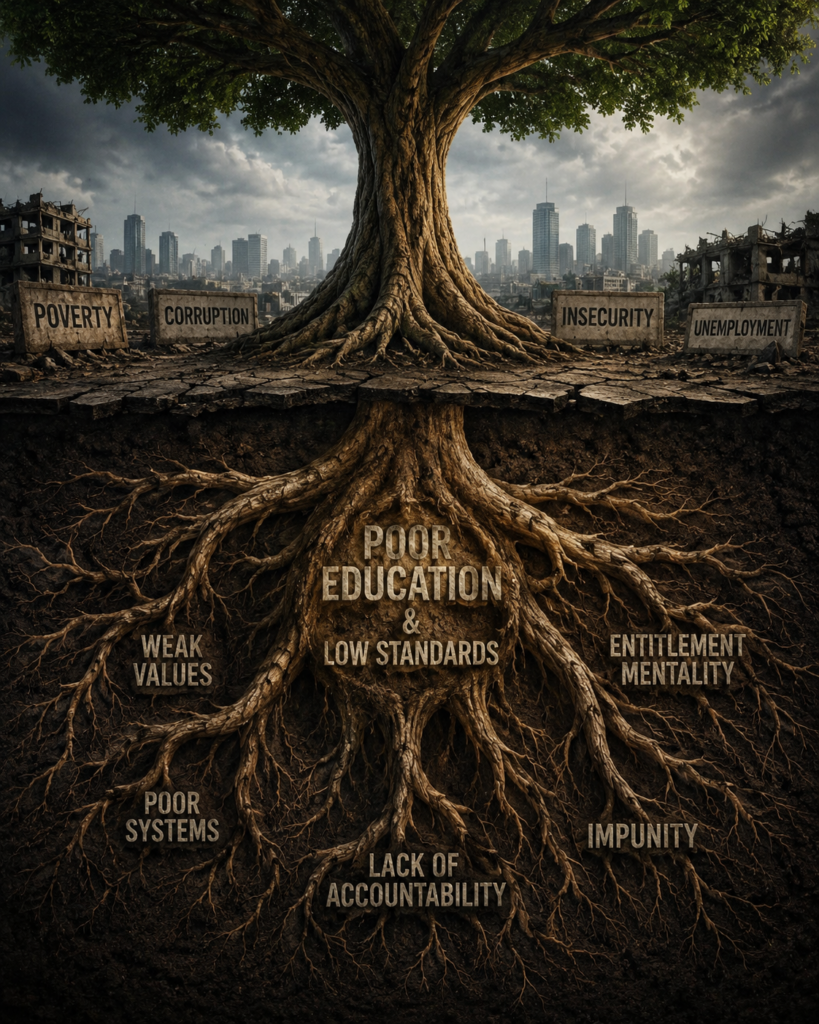
Nigeria’s problems are often discussed in terms of corruption, weak institutions, or poor leadership. But beneath all of these lies a more foundational issue—education, not just as schooling, but as a system that shapes thinking, discipline, and accountability.
At present, there is a visible shift in how some national institutions respond to misconduct. The office of the Inspector General of Police has shown signs of increased responsiveness. Public complaints—especially those amplified through social media—are no longer ignored as easily as they once were. Officers are sometimes queried, sanctioned, or even arrested when credible evidence emerges. This suggests that, at the top, there is at least an awareness that public trust must be earned and maintained.
Yet, despite this effort, the persistence of misconduct at the lower levels reveals a deeper problem. The issue is not simply about leadership at the top; it is about the quality, mindset, and formation of those who make up the system. When institutions such as the Nigeria Police Force or the Nigerian Armed Forces are populated through compromised entry processes—whether by favoritism, influence, or other unmerited means—the foundation becomes weak. No amount of top-down enforcement can fully correct a system that is structurally flawed at the point of entry.
This brings us back to education—not merely as a certificate, but as a filter and a formative process. Raising the minimum standard for entry into critical institutions, such as requiring a first degree, may not eliminate misconduct. A university education does not automatically produce integrity. However, it introduces something important: exposure, structure, and, to some extent, awareness of consequences.
A person who has spent years in a structured academic environment is more likely to understand systems, rules, and the implications of breaking them. Even when such individuals engage in wrongdoing, they tend to do so with an awareness that actions have consequences. This awareness, however imperfect, can act as a restraint. It can reduce impulsiveness and introduce calculation—an understanding that misconduct carries risks that must be avoided or managed.
Critics may argue that many highly educated individuals in Nigeria—politicians, executives, and public officials—still engage in corruption. This is true. However, their actions often reveal a different pattern. They operate with caution, using systems, loopholes, and cover to shield themselves. While this does not justify their actions, it highlights a key point: education influences behavior, even in wrongdoing. It introduces strategy where there might otherwise be recklessness.
Now, imagine combining this baseline of awareness with a truly functional legal and enforcement system—one that is capable of detecting, exposing, and prosecuting misconduct effectively. In such a scenario, the same “intelligence” used to evade the law would become insufficient. The system would then be strong enough to identify and remove bad actors, regardless of how calculated they are.
The real goal, therefore, is not to create “smarter offenders,” but to build a society where education shapes citizens who understand both the value of integrity and the inevitability of accountability. When individuals know—deeply and convincingly—that misconduct will lead to consequences, behavior begins to change.
Nigeria’s path forward requires more than reactive enforcement. It demands a proactive restructuring of how people enter and operate within institutions. Merit must replace influence. Standards must replace shortcuts. Education must move from being a mere qualification to becoming a true foundation for national development.
Until this shift happens, efforts at reform—no matter how well-intentioned—will continue to address symptoms rather than the root cause. And that root, as uncomfortable as it may be to admit, remains the quality of education and the standards by which individuals are formed and admitted into the systems that govern us all. The guardians of education have failed us all and this is the root of Nigeria’s problems.
Written by:
Mr. Otokiti Olaoluwa